

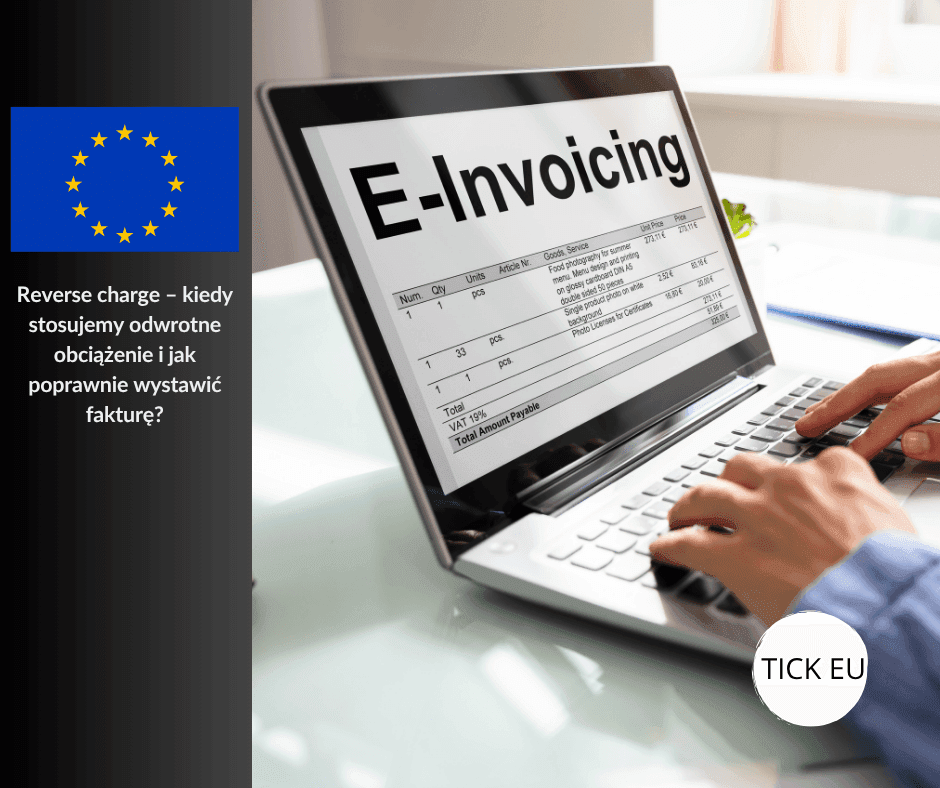
The reverse charge mechanism has raised many questions among entrepreneurs involved in international transactions for years. The issue arises particularly when a company issues an invoice to a foreign contractor or purchases services from another EU country. Many people are still uncertain about when VAT should be charged and when the tax liability is transferred to the buyer.
Reverse charge, as the term suggests, is no longer applied in Poland to the same extent as it was several years ago in domestic transactions, but it still operates in international trade and B2B relationships. Therefore, incorrectly marking an invoice or applying the wrong VAT rate may lead to corrections, settlement problems, and inquiries from the tax authorities.
Key information from the article
Reverse charge means transferring the VAT settlement obligation from the seller to the buyer.
Reverse charge VAT most commonly occurs in international transactions and services between companies within the EU.
Reverse charge on an invoice should be marked with an appropriate note and issued without charging VAT.
A reverse charge invoice for a foreign contractor requires both parties to have active EU VAT numbers.
Whether reverse charge applies depends primarily on the type of transaction, the place of supply of services, and the taxpayer’s status.
What is reverse charge and how does it work?
Simply put, reverse charge means that the buyer settles VAT instead of the seller. The seller issues an invoice without tax, while the buyer calculates and settles VAT according to the regulations of their own country.
The reverse charge mechanism is mainly applied to international transactions between VAT taxpayers. This mechanism is intended to reduce tax abuse and simplify settlements between companies from different countries.
For example: a Polish company provides marketing services to a contractor in Germany. The place of taxation is the buyer’s country, namely Germany. Therefore, the Polish company issues an invoice without VAT and includes the note “reverse charge”, while the German contractor settles the tax in Germany.
It is worth remembering that reverse charge does not mean VAT exemption. The tax still exists, but the obligation to settle it is transferred to the other party in the transaction.
Reverse charge – when is it applied to foreign services?
The reverse charge mechanism most commonly appears when providing services to companies from other European Union countries. This includes, among others, marketing, IT, consulting, accounting, and advertising services.
Reverse charge for VAT applies when both the service provider and the service recipient are VAT taxpayers, and the place of taxation is located in the buyer’s country. In practice, this means that a Polish company does not add Polish VAT to the invoice.
To correctly apply EU reverse charge VAT, several conditions must be met:
both parties must be business entities;
the contractor should have an active EU VAT number;
the service must fall under the general rule set out in Article 28b of the VAT Act;
the invoice should contain the wording “reverse charge.”
Before issuing the document, it is worth checking the contractor’s EU VAT number in the VIES system. This is a simple step that may protect the company from incorrectly settling the transaction.
What should a reverse charge invoice look like?
An invoice issued under the reverse charge procedure looks similar to a standard VAT invoice, but it contains several important differences. The most significant one is the absence of charged tax.
Reverse charge on an invoice means that the seller does not indicate a VAT rate or VAT amount. Instead, they include an appropriate note informing about the reverse charge mechanism. The following designations most commonly appear on the document:
“reverse charge”;
“reverse charge mechanism”;
“VAT to be settled by the buyer”;
“tax to be accounted for by the recipient.”
Reverse charge in English is most commonly written simply as “reverse charge.” Such information is particularly important when cooperating with foreign contractors.
Pro tip: if you are issuing an invoice to a company outside Poland, it is worth including the EU VAT numbers of both parties as well. This makes the document clearer for accounting departments and tax offices.
Does reverse charge apply only within the European Union?
No. The reverse charge mechanism may also apply to transactions with companies outside the EU. The key factor here is the place of supply of services and local tax regulations.
Reverse charge of VAT often appears in services provided to contractors from the United Kingdom, Norway, or Switzerland. In such situations, a Polish entrepreneur also usually issues an invoice without domestic VAT.
However, caution is necessary, as settlement rules may vary depending on the country. Sometimes a foreign contractor requires additional markings or specific wording on the invoice.
A good practice is to agree in advance with the client on what information should be included in the document. This helps avoid corrections and payment delays.
What information must a reverse charge invoice contain?
The basic elements remain the same as for a regular VAT invoice. The document should include the issue date, the parties’ details, invoice number, description of the service or goods, and sales value.
A reverse charge invoice for a foreign contractor must additionally include information about the application of the reverse charge procedure. In many cases, providing the EU VAT numbers of both parties is also required.
The most common additional elements are:
the note “reverse charge”;
the seller’s EU VAT number;
the buyer’s EU VAT number;
no VAT rate and VAT amount;
the net transaction amount.
An error in invoice markings may result in the need to issue a correction. Therefore, it is worth using accounting software that automatically adds the appropriate markings.
Does reverse charge still apply in Poland?
This is one of the most frequently asked questions. Several years ago, reverse charge also functioned in selected domestic transactions, for example in the construction industry or electronics trade. Currently, most of these cases have been replaced by the split payment mechanism.
Reverse charge VAT in domestic transactions now has much more limited application than before. However, it still applies to certain international transactions and services provided between taxpayers.
Therefore, entrepreneurs often encounter situations where reverse charge mainly appears on foreign invoices. This particularly concerns companies providing online services, IT, marketing, or consulting services.
How to settle reverse charge in a VAT return?
Issuing an invoice without VAT is only the first step. The transaction must also be correctly reported in declarations and JPK files.
Reverse charge VAT requires proper recognition both on the sales side and when purchasing foreign services. In the case of service imports, the entrepreneur usually reports both output VAT and input VAT simultaneously.
For many companies, this means tax neutrality. The tax is reported formally but does not increase the actual operating cost.
Worth knowing: errors in settling foreign services are among the areas most frequently reviewed in VAT inspections. This particularly concerns situations where an entrepreneur uses advertising services, SaaS subscriptions, or cooperates with freelancers from abroad.
When can reverse charge not be applied?
Not every international transaction is automatically subject to reverse charge. There are situations where Polish VAT must be charged or completely different taxation rules apply.
Whether reverse charge applies depends, among other things, on the type of service, the buyer’s status, and the place of supply. If the client is not a VAT taxpayer or acts as a private individual, the mechanism usually does not apply.
Problems also arise with services related to real estate, transport, or in-person events. Such services are often subject to separate tax rules.
Example: a Polish company organizes an in-person training course in France for private individuals. In this situation, reverse charge may not apply, even though the service is provided to foreign recipients.
Why do entrepreneurs struggle with reverse charge on foreign invoices?
The greatest challenge is usually not issuing the invoice itself, but determining the place of taxation. This is what determines whether VAT should be settled in Poland or by the foreign contractor.
Reverse charge on a foreign invoice requires prior determination of where a particular service is taxable. Without this knowledge, mistakes are easy to make.
Common mistakes include:
issuing an invoice with Polish VAT despite the reverse charge obligation;
lack of the contractor’s EU VAT number;
incorrect wording on the invoice;
incorrect reporting of the transaction in JPK;
failure to include imported services.
That is why companies cooperating internationally increasingly consult such transactions with their accounting department even before issuing the document.
Frequently asked questions about reverse charge
Are reverse charge and “odwrotne obciążenie” the same thing?
Yes. Reverse charge in Polish means “odwrotne obciążenie” (reverse charge mechanism). Both terms refer to a mechanism in which the buyer settles VAT instead of the seller.
Is a VAT rate included on a reverse charge invoice?
No. Reverse charge on an invoice means that the seller does not charge VAT. The document only includes the net value and the appropriate note.
Is every foreign invoice subject to reverse charge?
No. Everything depends on the type of transaction, the place of supply of services, and the buyer’s status. In some cases, VAT may need to be charged according to local rules.
How can you check whether a contractor has an active EU VAT number?
The safest way is through the VIES system operated by the European Commission. Verification usually takes only a few seconds.
Does reverse charge apply to services outside the EU?
Yes. A reverse charge invoice may also apply to contractors outside the European Union if regulations require VAT to be settled by the buyer.