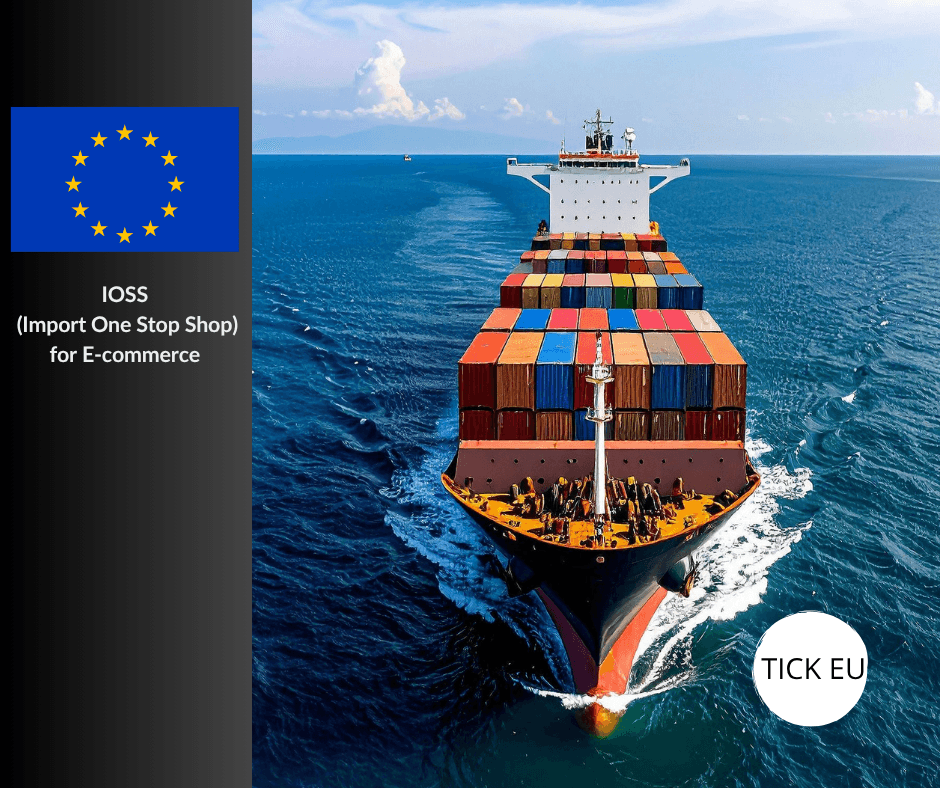
IOSS (Import One Stop Shop) for E-commerce
Selling online to customers across the European Union increasingly requires businesses to account for VAT in multiple countries. This particularly affects businesses importing goods from outside the EU and selling them to consumers within the European market. In response to these challenges, the European Union introduced the Import One Stop Shop (IOSS) procedure.
This mechanism simplifies VAT reporting for low-value imported consignments and reduces customs clearance formalities. As a result, both sellers and buyers can avoid many of the issues that were common in cross-border trade just a few years ago.
Key takeaways
- IOSS is a special VAT scheme designed for the sale of goods imported from outside the European Union.
- The scheme applies to consignments with a value of up to EUR 150.
- Sellers can report VAT for all EU Member States through a single VAT return.
- Customers do not pay VAT upon delivery of the shipment.
- IOSS simplifies VAT compliance for international e-commerce businesses.
What is IOSS VAT and why was it introduced?
IOSS is a VAT scheme that allows businesses to account for VAT on goods imported from third countries and sold to consumers within the European Union. Its purpose is to simplify VAT reporting and reduce administrative burdens.
The Import One Stop Shop (IOSS) was introduced on 1 July 2021 as part of the EU VAT e-commerce package. Before that date, consignments valued at up to EUR 22 were exempt from VAT. This created unfair competition between EU-based sellers and businesses located outside the EU. The new legislation abolished that exemption while simultaneously introducing IOSS to make VAT compliance easier for businesses. As a result, VAT is collected at the time of purchase rather than when the goods are delivered to the customer.
For consumers, this means greater price transparency. The price displayed during checkout already includes VAT, eliminating additional charges upon delivery.
When can the IOSS VAT scheme be used?
The scheme is available only for specific types of sales. Not every import transaction qualifies.
IOSS applies to distance sales of goods imported from countries outside the European Union to customers who are private consumers. The value of the consignment must not exceed EUR 150. This threshold applies to the value of the goods only and excludes transportation and insurance costs if these are separately stated on the invoice.
For example, an online store based in China selling electronic accessories worth EUR 80 to a customer in Poland may report VAT through IOSS. However, if the value of the shipment is EUR 250, the standard import VAT procedures must be applied.
It is important to remember that the scheme does not cover excise goods such as alcoholic beverages or tobacco products.
How does VAT reporting work under the IOSS scheme?
VAT is collected from the customer at the time of purchase. The seller then reports and pays the tax through a single monthly VAT return submitted in the Member State of identification.
The mechanism is relatively straightforward. The seller determines the VAT rate applicable in the customer’s country and adds it to the product price during checkout. At the end of the month, the business submits an IOSS return and pays the total amount of VAT due. The tax administration then distributes the appropriate amounts of VAT to the relevant EU Member States. IOSS eliminates the need for businesses to register for VAT in multiple EU countries.
For growing online stores, this represents a significant organizational and accounting advantage.
Who can register for IOSS?
Both EU-based businesses and companies established outside the European Union may use the scheme.
Businesses established in an EU Member State may register directly. Companies located outside the EU are often required to appoint an IOSS intermediary, who assumes responsibility for fulfilling their VAT obligations.
The businesses that most commonly use the scheme include:
- online stores importing goods from outside the EU;
- online marketplaces;
- companies engaged in cross-border sales;
- businesses operating under dropshipping models;
- logistics providers supporting international e-commerce.
Before registering, businesses should carefully analyze their business model and supply chain to ensure that the IOSS scheme is the most suitable solution.
How does the IOSS VAT registration process work?
The registration procedure depends on the Member State of identification and the status of the business. However, the process itself is not particularly complicated.
In Poland, registration is completed through the Polish tax administration. The business must provide its identification details and information about its commercial activities. Once the application has been approved, the business receives an individual IOSS identification number. This number is used during customs clearance procedures and when reporting sales. It plays a crucial operational role by allowing customs authorities to verify that VAT has already been collected at the point of sale.
Good to know
The IOSS identification number should not be disclosed to end customers. Its use is limited exclusively to customs, logistics, and tax reporting procedures.
Does IOSS eliminate the need for customs clearance?
No. The scheme does not remove customs formalities.
Imported goods must still be declared to customs, but the process is significantly simplified. Customs authorities receive confirmation that VAT has already been accounted for under the IOSS scheme. As a result, customers do not have to pay additional VAT charges when receiving their parcels. This reduces the likelihood of customers refusing deliveries and improves the overall shopping experience. For large-scale e-commerce businesses, this has a direct impact on conversion rates and the number of returned shipments.
What happens if a shipment exceeds the value of EUR 150?
In such cases, the IOSS scheme cannot be used.
The import must be processed under the standard customs procedures. VAT and any applicable customs duties are assessed during customs clearance. For example, a customer ordering electronic equipment worth EUR 500 cannot benefit from the simplified IOSS procedure. The goods will be processed under the standard import rules.
For this reason, businesses should monitor the value of individual consignments and design their sales models accordingly.
What are the benefits of IOSS VAT for online sellers?
The greatest advantage of the scheme is the simplification of VAT compliance.
A business can sell to customers in multiple EU Member States without having to register separately for VAT in each country.
The main benefits include:
- a single VAT return for all EU Member States;
- reduced administrative costs;
- faster customs clearance;
- greater price transparency for customers;
- a lower risk of VAT compliance issues.
IOSS helps improve the competitiveness of online stores selling goods imported from outside the European Union. This is particularly important for businesses operating through online marketplaces and companies engaged in large-scale international e-commerce.
Is IOSS also beneficial for customers?
Yes. The benefits are not limited to sellers—they also extend to consumers.
Customers know the full purchase price before completing their order. They are not charged additional VAT when the shipment is delivered. This significantly reduces the number of refused deliveries and complaints resulting from unexpected costs. From the customer’s perspective, the purchasing process becomes more predictable and transparent.
What are the most common mistakes when using IOSS?
Incorrect application of the scheme may lead to both tax and logistical issues.
The most common mistakes include:
- applying IOSS to consignments exceeding EUR 150;
- using the wrong VAT rate for the customer’s country;
- incorrect sales reporting;
- improper use of the IOSS identification number;
- insufficient control over the logistics process.
Pro tip
If you sell to customers in multiple EU Member States, it is worth using software that automatically assigns the correct VAT rates for each country. This reduces the risk of errors and makes VAT reporting much more efficient.
Frequently Asked Questions about IOSS VAT
Is IOSS mandatory?
No. The use of the IOSS scheme is voluntary. Businesses may continue to account for imports under the standard import VAT rules.
Does IOSS cover all imported goods?
No. The scheme applies only to consignments with a value of up to EUR 150 and does not cover excise goods.
Can businesses established outside the EU use IOSS?
Yes. However, in many cases they are required to appoint an IOSS intermediary responsible for fulfilling their VAT obligations.
How often must an IOSS return be submitted?
IOSS returns are submitted monthly and include all sales covered by the scheme during the relevant reporting period.
Does IOSS replace the OSS scheme?
No. OSS and IOSS apply to different types of transactions. OSS primarily covers intra-EU sales, whereas IOSS applies specifically to the import of goods from countries outside the European Union.