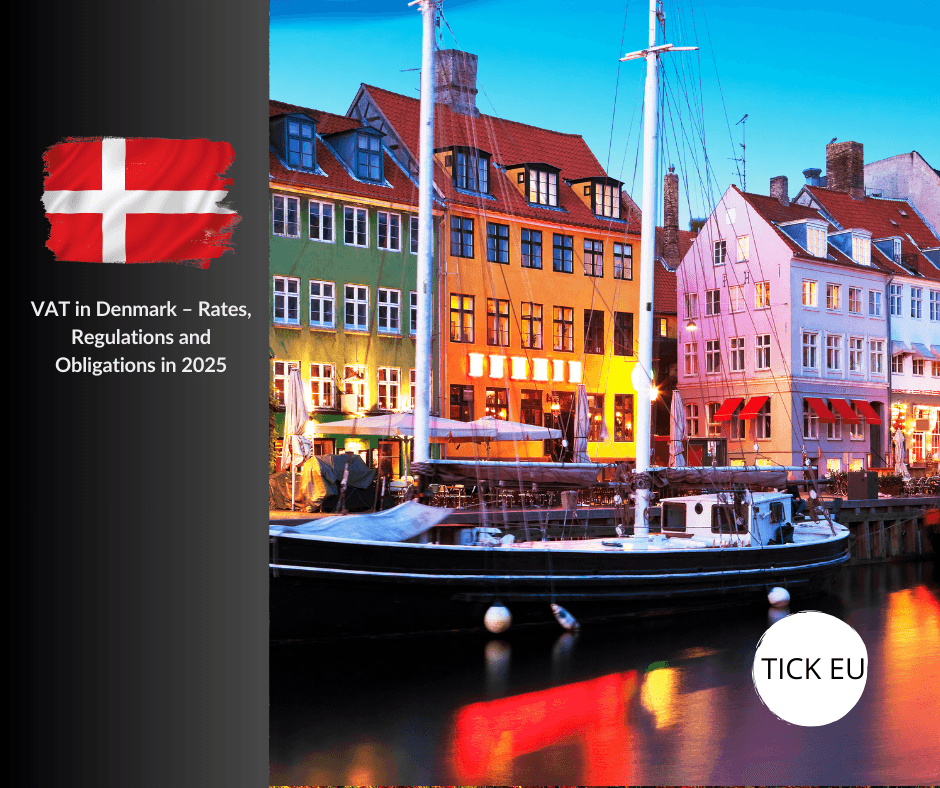
The VAT system in Denmark is considered one of the simpler ones in the European Union, but this does not mean it does not require knowledge of local rules.
If you run a business, import goods, provide services on the Danish market, or simply want to understand how much a purchase in Denmark costs “including VAT,” this article will clear up all doubts. You will find out what the VAT rate in Denmark is, who and when must register, and which VAT rules apply in 2025.
How does VAT work in Denmark?
VAT in Denmark (Danish: moms) is a value-added tax charged on most sales of goods and services. The system is based on EU directives, so its structure is similar to that of other EU countries. In practice, this means the seller adds VAT to the net price, and the customer pays the gross amount. Businesses can deduct input VAT on purchases related to their economic activity.
In Denmark, VAT is centrally managed by the tax authority SKAT, and all records and VAT returns are handled online. VAT registration is done electronically and is mandatory for companies that exceed the turnover threshold required by Danish law. It is worth noting that the Danish system does not provide many exceptions — in this respect, it is quite binary.
What is the VAT rate in Denmark in 2025?
The standard VAT rate in Denmark is 25%, and this has not changed for many years. It is one of the highest VAT rates in the European Union. Denmark does not apply classic reduced VAT rates (such as 5% or 8%) known from other countries. In some cases, a 0% rate or a VAT exemption applies, but only in strictly defined situations.
For example, the zero rate applies to exports of goods outside the European Union and to certain transport services under specific conditions.
So if you are wondering what VAT applies to standard goods or services in Denmark, the answer is simple: 25%.
Are reduced VAT rates applied in Denmark?
No. The Danish VAT system does not include a catalogue of reduced rates like many other EU countries. You will not pay a reduced rate for hotels, books, food, or newspapers — everything that is not explicitly exempt by law is subject to the 25% VAT rate.
This means that food purchased in supermarkets, newspapers, and cinema tickets are also taxed at the full rate. From this perspective, the Danish VAT system is simple, but it may surprise those accustomed to more nuanced tax structures.
How much VAT applies to different goods and services in Denmark?
Since there is only one standard rate, most goods and services are subject to 25% VAT. Exceptions include:
export of goods outside the EU – 0% VAT
financial and insurance services – VAT exempt
educational, cultural, and healthcare activities – partially exempt
rental of residential property – VAT exempt
In all other cases, including e-commerce, dropshipping, and B2B sales, VAT in Denmark is 25%.
VAT registration obligation in Denmark
If you operate a business in the EU and start selling goods or services in Denmark, you must know when VAT registration becomes mandatory.
The turnover threshold after which VAT registration in Denmark is required is 50,000 DKK (approx. EUR 6,700) per year. This is a very low threshold. Registration is required not only for Danish companies but also for foreign entities carrying out business activities in Denmark.
In practice, if you run an online store (e.g. from Poland) and sell goods to Danish consumers, after exceeding the threshold you must charge Danish VAT and report it to SKAT. This can be done via the OSS system, but not always — it depends on the type of transaction.
How is VAT settled in Denmark?
After registration, the company receives a CVR number (central registration number, which also serves as the VAT number) and is obliged to:
charge VAT at local rates (25%),
issue invoices in accordance with Danish requirements,
submit periodic VAT returns (usually quarterly or monthly),
keep accurate records of sales and purchases.
All settlements are handled electronically, and the Danish tax authorities place strong emphasis on transparency and data accuracy. Errors may result in financial penalties or withdrawal of the VAT number.
VAT in Denmark and intra-Community sales
Sales of goods or services to business customers in Denmark (registered as EU VAT taxpayers) are generally not taxed in the seller’s country. In such cases, the reverse charge mechanism applies — the Danish buyer accounts for VAT themselves.
If the customer is a private individual (e.g. buying from your online store), the place of taxation is the country of consumption. This means that above certain sales thresholds you must charge Danish VAT and report it to SKAT.
VAT refund in Denmark for foreign companies
Companies without a permanent establishment in Denmark that have paid Danish VAT (e.g. for trade fairs, hotel services, car leasing) may apply for a VAT refund. Applications are submitted via the domestic tax portal (e.g. in Poland via the e-Tax Office), which forwards the claim to the Danish tax authorities.
The process usually takes several months, but Denmark is known for relatively efficient handling of such requests. Complete documentation is essential: invoices, proof of payment, and a description of the business purpose of the expense.
Why is it important to know Danish VAT rates?
Knowing Danish VAT rules helps avoid costly mistakes. Without understanding local regulations, it is easy to issue incorrect invoices, miss registration obligations, or incorrectly report sales.
By knowing answers to questions like “what is the VAT rate in Denmark?” you can better plan pricing policies, include additional costs, and adjust your sales strategy to local conditions.
What does this mean in practice?
VAT in Denmark is one of the most transparent systems in Europe — one rate, simple structure, low registration threshold, and fully digital reporting.
The Danish VAT rate is 25% and applies to almost all goods and services. Reduced rates do not exist. Exemptions or the 0% rate apply only in specific, clearly defined cases. If you operate in e-commerce, services, or international trade, Danish VAT will sooner or later apply to you. Knowing the rules and complying with them from day one is essential.