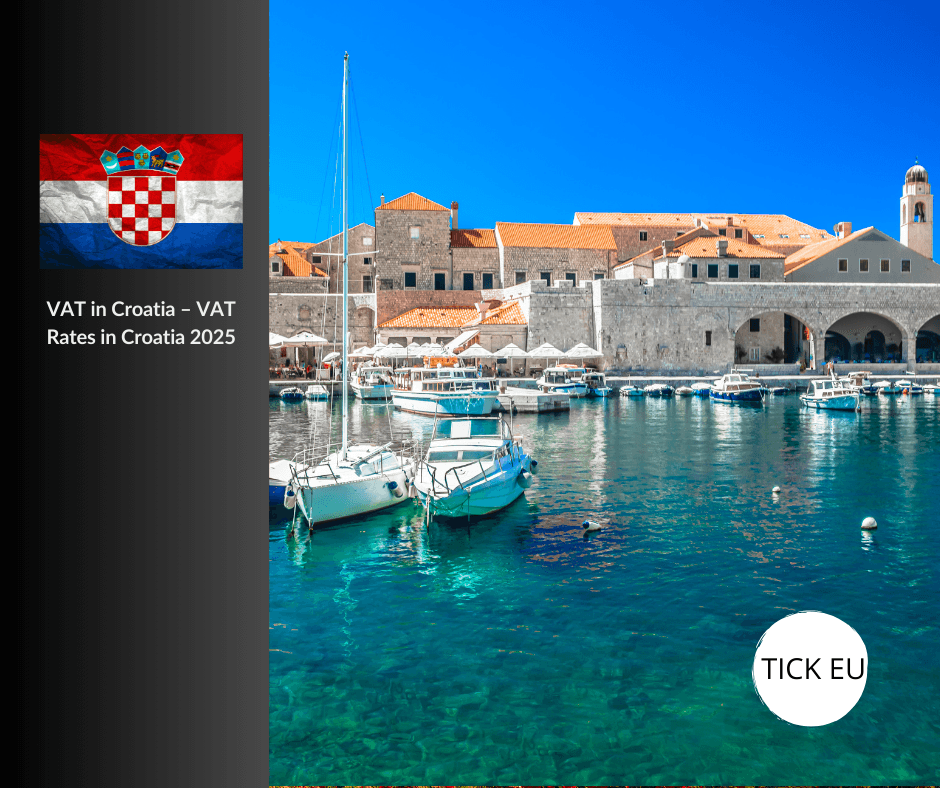
If you’re interested in how VAT works in Croatia in 2025 – you’re in the right place.
In this text, I explain how the system works, what the VAT rates are, who must apply them, and what to pay attention to – in clear, simple language.
VAT in Croatia – basics
The VAT system in Croatia works similarly to other EU countries. Value Added Tax is applied to most goods and services. The seller adds VAT to the price, and the consumer pays the gross amount. For businesses, VAT is settled via VAT returns, and entrepreneurs are entitled to deduct input VAT on purchases.
The same VAT rules also apply to entrepreneurs from outside Croatia who sell goods or services on the Croatian market – meaning the correct VAT rate must be applied, registration completed, and tax settled if required.
How much is VAT in Croatia in 2025?
If you’re wondering how much VAT is in Croatia, here’s the answer. In 2025, the following VAT rates apply: a standard rate and reduced rates.
The standard VAT rate is 25% – applied to most goods and services.
Reduced VAT rates are 13% and 5% – applicable to selected categories of goods and services.
In specific situations, a 0% VAT rate may apply – for example, exports or intra-Community supplies to companies registered for VAT-EU.
So, when someone asks what VAT rate applies in Croatia, remember it can be 25%, 13%, 5%, or 0%, depending on the transaction.
When are reduced VAT rates applied?
Not all products and services are subject to the highest rate. The 13% reduced rate often applies to accommodation services (hotels, guesthouses, campsites), as well as publications, press, or other goods specified in tax regulations.
The 5% rate may apply to certain food products, basic necessities, or special services – but the scope depends on regulations and may change.
The 0% VAT rate in Croatia most commonly applies to international transactions – such as exports outside the EU or intra-Community supplies – provided formal requirements are met (buyer’s VAT-ID, transport documents, etc.).
Who and when must register for VAT in Croatia?
If you run a business in Croatia or sell goods/services there, you need to know when Croatian VAT applies to you. In 2025, the VAT registration threshold for small businesses has been increased – meaning companies below the threshold may operate without VAT registration if conditions are met.
Once the threshold is exceeded, you must complete formalities: obtain a VAT-ID number (locally HR + number), keep sales and purchase records, file VAT returns, and apply the correct VAT rates.
For foreign companies – e.g. from other EU countries – selling to customers in Croatia may require VAT registration if specific thresholds are exceeded or if you sell directly on the local market.
VAT in Croatia for international sales
If you sell from Poland or another EU country to Croatia, EU VAT rules apply. For sales to consumers (B2C), you must charge Croatian VAT once the distance-selling threshold is exceeded – or settle VAT via the OSS mechanism.
If you sell to a business with a valid VAT-ID (B2B), the reverse-charge mechanism often applies – meaning the buyer accounts for VAT. In that case, VAT is not added to the invoice.
For exports outside the EU or intra-Community supplies, a 0% VAT rate may apply if all requirements are met (transport documents, buyer’s VAT-ID, proof of shipment).
Why is it worth knowing VAT rates in Croatia?
If you plan purchases, business operations, or selling goods/services in Croatia, understanding the Croatian VAT system helps you anticipate costs, tax burdens, and avoid surprises. You’ll know whether a product will be more expensive due to VAT or whether VAT registration is required.
For businesses, this is crucial for pricing, margins, import/export costs. For consumers, VAT is part of the gross price you pay, making it easier to compare prices across countries.
In conclusion…
VAT in Croatia operates on three levels: 25% standard, 13% and 5% reduced, and occasionally 0%. In most cases, goods and services are taxed at 25%. However, accommodation services, selected media, and special products may fall under 13% or 5%. International transactions may qualify for 0% VAT.
If you run or plan to run a business on the Croatian market, it’s worth knowing the registration thresholds, documentation requirements, and settlement rules. This way, you avoid problems and structure your offer correctly.